
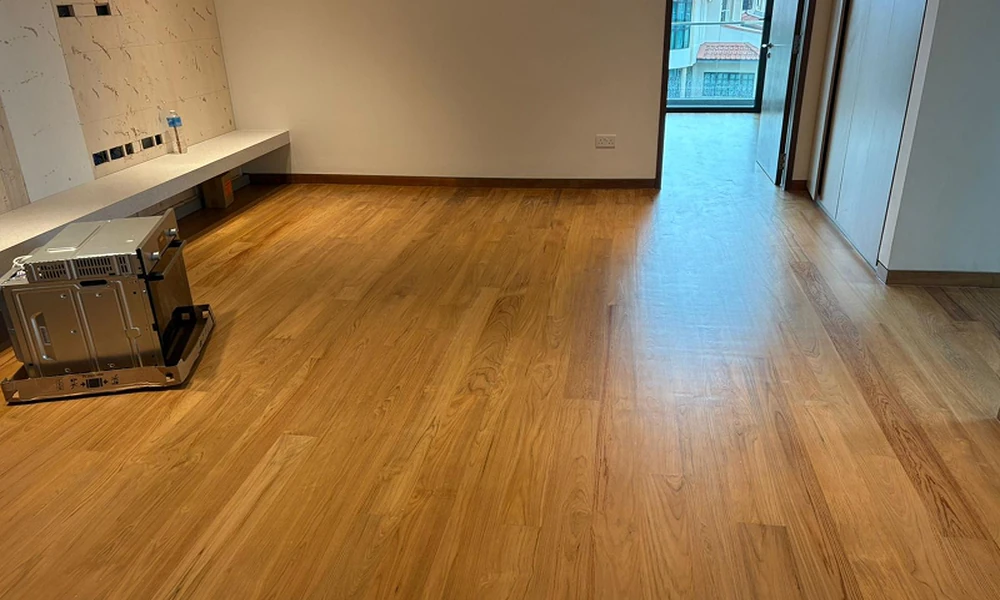
Wood flooring can make a room feel settled in a way that paint, furniture and lighting sometimes cannot. But choosing it is less about finding the prettiest plank and more about understanding how the floor will behave after the showroom feeling has worn off.
In Singapore, that matters. You are choosing a floor for a warm, humid environment, so the details of construction deserve as much attention as colour and grain. If you are comparing your options, this guide to wood flooring in Singapore is a useful place to start, particularly if you are considering engineered wood.
Start With Your Room
The same flooring can behave differently in different parts of a home. A bright living room with strong afternoon sun has different demands from a shaded bedroom. An entrance hall has to tolerate shoes, grit and repeated traffic that a quiet study may barely encounter.
Think about what happens in the room rather than what the room looks like in a photograph.
Ask yourself:
- How much direct sunlight reaches the floor?
- Will people walk through it constantly?
- Is furniture likely to be moved often?
- Are spills likely to happen?
- Do you want the floor to look almost unchanged for years, or are you comfortable with signs of use?
That last question is surprisingly important. A floor is not a museum display. Timber changes as it is lived on.
Understand Engineered Wood
Engineered wood is often discussed as though it were simply a cheaper substitute for solid timber. That misses the interesting part.
Its construction combines a real wood surface with supporting layers beneath it. The result is a floor that can offer the appearance and tactile qualities of timber while being designed differently from a solid wood board.
The useful question is therefore not simply, “Is engineered wood good?” It is, “Is this particular construction suitable for the room I have?”
Look at the thickness and specification of the wear layer, the construction beneath it and the installation requirements. Two floors that look nearly identical on a sample board can have quite different practical characteristics.
The Humidity Trade Off
Here is the less obvious trade-off: choosing wood flooring for a humid climate is not just about choosing a moisture-resistant product. Installation and environmental control matter alongside the material itself.
Wood naturally responds to changes in moisture. If you focus entirely on the surface appearance and ignore the conditions underneath it, you can end up solving the wrong problem.
For example, imagine a new flat where the air-conditioning is used heavily during the day but the home becomes warm and closed up while nobody is there. The floor experiences a changing environment rather than one perfectly stable set of conditions.
That does not automatically make wood unsuitable. It means the flooring specification, acclimatisation, subfloor condition and installation method should be considered together.
Do Not Choose By Colour
A sample board can be wonderfully persuasive. You hold it beside the sofa, admire the grain and imagine the finished room. Then six months later, the room has different curtains, different daylight and a dining table sitting across half the floor.
Colour is still important, but consider the character of the timber as well.
A strongly patterned grain can become a visual feature in its own right. A quieter grain may allow furniture and artwork to take the attention. Darker floors can make a space feel more enclosed, while lighter timber can give the room a more open appearance.
There is another practical consideration: dust and small marks do not necessarily behave the way you expect from a showroom sample. A floor with variation in tone and grain can disguise everyday changes differently from a very uniform surface.
Calculate The Real Cost
The common mistake is to compare flooring by the price of the boards alone.
Suppose two flooring options cover the same 50-square-metre home. One costs £40 per square metre and another £55. The apparent difference is £750 for the flooring material. But the final project cost can also involve preparation, installation, trims, removal of an existing floor and other site requirements.
The decision rule is simple:
Compare the installed cost and expected maintenance requirements, not just the price per square metre.
This is particularly useful when you are working with a renovation budget. A cheaper material can become less economical if it creates additional work elsewhere, while a more expensive specification may make sense if it solves a particular installation requirement.
Live With The Timber
There is a small psychological trap in choosing flooring. People often ask which colour will make their home look best, when the more useful question is which floor they will still enjoy after ordinary life has happened on it.
Picture the floor after a rainy afternoon, after someone has dragged a chair across the dining area, after sunlight has moved across it for several hours. Picture a few scratches. Picture the grain becoming familiar rather than new.
That is when the decision becomes clearer.
If you want to explore different timber flooring specifications before deciding, FloorXpert can give you another reference point for understanding the available options rather than choosing solely from a small sample.
The best wood flooring choice is rarely the one that wins a beauty contest in the showroom. It is the one whose construction, appearance and everyday behaviour make sense for the particular rooms you live in. A floor becomes part of the background of your life, which is precisely why choosing it deserves a little more thought than the sample board might suggest.